The answer to which appliance uses more electricity—an oven or an air fryer—is usually an oven. While ovens have higher wattage, air fryers typically cook food faster, impacting overall energy consumption. This post delves into the air fryer energy consumption vs. oven energy consumption in detail, helping you make informed decisions about energy efficient cooking methods and minimize your electricity cost air fryer vs oven.
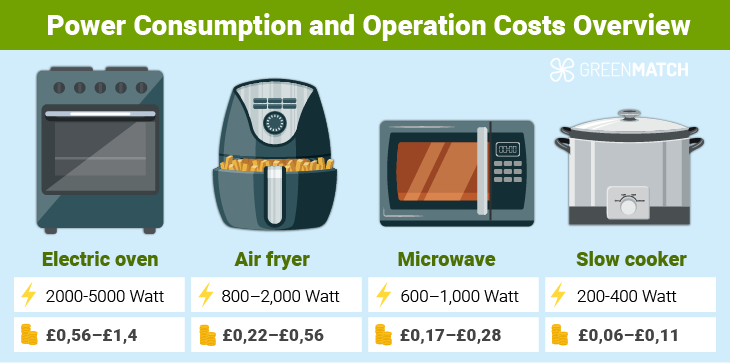
Image Source: cdn.greenmatch.co.uk
Fathoming Appliance Power Consumption
To accurately compare the appliance energy consumption comparison between ovens and air fryers, we need to look at air fryer wattage vs oven wattage, along with how long each appliance is used. Oven power usage and air fryer power usage are key factors, but time also plays a critical role.
Demystifying Wattage: Ovens vs. Air Fryers
- Ovens: Standard ovens typically range from 2,000 to 5,000 watts. Electric ovens generally use more power than gas ovens because gas ovens use gas for heating, only using electricity for light and fan.
- Air Fryers: Air fryers usually range from 800 to 1,800 watts. This is significantly lower than most ovens.
Table 1: Typical Wattage Ranges
| Appliance | Typical Wattage |
|---|---|
| Oven | 2000 – 5000W |
| Air Fryer | 800 – 1800W |
Power Consumption Calculation: A Simplified View
To calculate energy efficient cooking methods, figure out how much energy each appliance uses in kilowatt-hours (kWh). The formula is:
(Wattage / 1000) x Hours of Use = kWh
For example:
- A 3000-watt oven used for 1 hour consumes 3 kWh.
- A 1500-watt air fryer used for 30 minutes (0.5 hours) consumes 0.75 kWh.
Unveiling the Impact of Cooking Time
While ovens consume more power per hour, they aren’t always the less energy efficient option. Cooking time is critical. Air fryers often preheat faster and cook food more quickly than ovens.
Preheating and Cooking Times
- Ovens: Ovens take longer to preheat, usually 10-20 minutes. Cooking times are often longer.
- Air Fryers: Air fryers preheat rapidly, typically in 3-5 minutes, and cooking times are generally shorter.
A Real-World Example
Let’s compare cooking a batch of fries:
- Oven: Preheat for 15 minutes + cook for 25 minutes = 40 minutes (0.67 hours)
- Air Fryer: Preheat for 3 minutes + cook for 15 minutes = 18 minutes (0.3 hours)
Even though the oven has higher wattage, the shorter cooking time of the air fryer can make it the more energy efficient cooking methods.
Analyzing the Electricity Cost Air Fryer vs Oven
To accurately assess the electricity cost air fryer vs oven, you must know your electricity rate. This rate is usually listed on your electricity bill in cents per kWh.
Cost Calculation
The formula to calculate the cost is:
kWh x Electricity Rate = Cost
Using our previous example, let’s assume an electricity rate of $0.20 per kWh:
- Oven: 3 kWh x $0.20 = $0.60
- Air Fryer: 0.75 kWh x $0.20 = $0.15
In this case, the air fryer is significantly cheaper to use for this particular cooking task.
Oven vs Air Fryer Cost Comparison
| Appliance | Wattage | Cooking Time (Hours) | kWh | Electricity Rate | Cost |
|---|---|---|---|---|---|
| Oven | 3000W | 1 | 3 kWh | $0.20/kWh | $0.60 |
| Air Fryer | 1500W | 0.5 | 0.75 kWh | $0.20/kWh | $0.15 |
Delving Into Cooking Tasks
The appliance energy consumption comparison depends on the specific cooking task. Air fryers excel at cooking smaller portions and foods that benefit from circulating hot air. Ovens are better for larger meals and baking.
Suitable Foods for Air Fryers
Air fryers are ideal for:
- Fries
- Chicken wings
- Vegetables (like broccoli and Brussels sprouts)
- Small baked goods
Suitable Foods for Ovens
Ovens are better suited for:
- Roasts
- Casseroles
- Large batches of cookies or cakes
- Pizzas
The Impact of Portion Size
Smaller portions are usually more energy-efficient to cook in an air fryer. If you’re cooking for one or two people, the air fryer is likely the better choice. For larger families or gatherings, an oven might be more practical and even more energy-efficient if cooking multiple items simultaneously.
Identifying Energy Efficient Cooking Methods
Beyond choosing between an oven and an air fryer, other strategies can reduce your energy consumption:
- Use the Right Size Appliance: Choose the smallest appliance that can handle the job. A toaster oven might be more efficient than a full-sized oven for small tasks.
- Minimize Preheating: Only preheat when necessary, and reduce preheating time where possible.
- Cook Multiple Items at Once: Bake multiple dishes simultaneously to maximize oven usage.
- Avoid Opening the Oven Door: Each time you open the oven door, heat escapes, and the oven must use more energy to maintain the temperature.
- Use Energy-Efficient Cookware: Dark, heavy cookware absorbs heat better, potentially reducing cooking time.
- Keep Appliances Clean: A clean oven or air fryer operates more efficiently.
- Consider Convection Settings: Convection ovens and air fryers circulate hot air, cooking food faster and more evenly, saving energy.
Deciphering the Long-Term Cost
The air fryer vs oven cost comparison isn’t just about electricity bills. You also need to consider the initial cost of the appliance.
Initial Investment
- Air Fryers: Typically cost between $50 and $200.
- Ovens: Ranges from several hundred to thousands of dollars, depending on the type and features.
Appliance Lifespan
Both ovens and air fryers can last for several years with proper care. However, air fryers may have a shorter lifespan due to their more frequent use for smaller meals.
Maintenance Costs
Maintenance costs are generally low for both appliances. Regular cleaning is essential to prevent breakdowns and ensure efficient operation.
Grasping Alternative Cooking Appliances
Beyond ovens and air fryers, several other cooking appliances offer varying degrees of energy efficiency:
- Microwave Ovens: Very efficient for reheating and cooking small portions.
- Toaster Ovens: A good compromise between an air fryer and a full-sized oven for smaller tasks.
- Induction Cooktops: Highly energy-efficient because they heat the cookware directly, minimizing heat loss.
- Slow Cookers: Excellent for long, slow cooking at low temperatures, using minimal energy.
Table 2: Energy Efficiency of Various Cooking Appliances
| Appliance | Energy Efficiency | Best Use Cases |
|---|---|---|
| Microwave Oven | High | Reheating, small portions |
| Toaster Oven | Medium | Small baking tasks, toasting |
| Induction Cooktop | High | Boiling, frying, simmering |
| Slow Cooker | High | Long, slow cooking |
Frequently Asked Questions (FAQ)
-
What is the most energy-efficient way to cook a small meal?
The most energy-efficient way to cook a small meal is often using a microwave or an air fryer. Microwaves are great for reheating, while air fryers excel at cooking smaller portions of foods like fries or chicken wings. -
Can I use an air fryer instead of an oven for everything?
No, you cannot use an air fryer for everything. Air fryers are best suited for smaller portions and foods that cook well with circulating hot air. Ovens are better for larger meals, baking, and recipes requiring consistent, even heat. -
Who should buy an air fryer?
Individuals or small families who frequently cook smaller portions of food and want a faster, more energy-efficient alternative to an oven should consider buying an air fryer. -
Are gas ovens more efficient than electric ovens?
Gas ovens typically use less electricity than electric ovens, as they primarily rely on gas for heating. However, the overall cost can depend on the relative prices of gas and electricity in your area. Electric ovens may also have features, such as precise temperature control, that some users prefer. -
How can I reduce my oven’s energy consumption?
To reduce your oven’s energy consumption, minimize preheating, avoid opening the door frequently, cook multiple items at once, use energy-efficient cookware, and keep the oven clean. -
What size air fryer is best for saving energy?
Choose an air fryer that is appropriately sized for your needs. A smaller air fryer will generally use less energy than a larger one, provided it can accommodate the food you need to cook. -
Is it cheaper to use an air fryer than an oven?
In many cases, yes. Air fryers typically use less energy than ovens for smaller portions and shorter cooking times. However, the exact electricity cost air fryer vs oven depends on wattage, usage time, and your electricity rate. -
What is the average lifespan of an air fryer?
The average lifespan of an air fryer is around 3-5 years, depending on the frequency of use and how well it’s maintained. Regular cleaning and proper care can extend its lifespan. -
Can I bake in an air fryer?
Yes, you can bake in an air fryer, but it’s best suited for smaller baked goods like muffins, cookies, and small cakes. Larger items may not cook evenly. -
Why is my electricity bill so high even though I use energy-efficient appliances?
Other factors can contribute to a high electricity bill, such as heating and cooling costs, lighting, water heating, and the energy efficiency of other appliances. Consider conducting a home energy audit to identify areas where you can save energy.
By taking a close look at how you cook, what you whip up in the kitchen, and the advice shared, you’ll be equipped to make smart choices about energy-saving cooking techniques. This will not only help you get the most out of your appliances, potentially saving you money on your electricity bill, but also nudge you towards a greener way of living.

I’m the recipe developer and food photographer behind Air Fryer at Tiffany’s. I’m also a wife, mom to two adventurous little boys, registered nurse, and live in the great Midwest. Join me as I show you new ways to use your air fryer that you never knew possible.