Yes, air fryers generally save energy compared to conventional ovens. They are smaller, heat up faster, and cook food quicker. This results in lower air fryer energy consumption and can translate into significant savings on your electricity bill. Let’s delve deeper into how air fryers stack up against other appliances and how to maximize your energy savings.
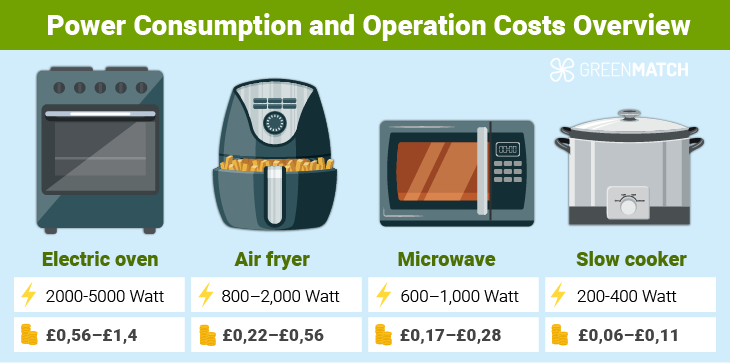
Image Source: cdn.greenmatch.co.uk
Air Fryer vs. Oven: A Breakdown of Energy Use
The primary advantage of an air fryer lies in its efficiency. It heats up much faster and uses less energy to cook the same food as a traditional oven. To understand this, let’s examine the factors contributing to air fryer vs oven energy use.
Preheating Time: A Major Energy Drain
Ovens require a significant amount of time to preheat, often 10-15 minutes. This preheating period consumes a considerable amount of energy, especially for larger ovens. Air fryers, on the other hand, preheat much faster – typically within 3-5 minutes, and sometimes even less. This shorter preheating time contributes significantly to lower electricity usage air fryer.
Cooking Time: Faster is Better
Air fryers cook food faster than ovens due to their concentrated heat and efficient air circulation. This reduced cooking time translates to less energy consumed. For instance, chicken wings might take 25 minutes in an air fryer compared to 40 minutes in an oven.
Size Matters: Oven Cavity vs. Air Fryer Basket
The size of the cooking appliance is crucial. An oven needs to heat a large cavity, requiring more energy. Air fryers, with their smaller baskets, heat up only the space needed for the food, making them more energy efficient cooking appliances.
A Comparative Look at Wattage: Air Fryer Wattage vs Oven
Let’s compare the wattage of a typical air fryer and an oven.
| Appliance | Average Wattage |
|---|---|
| Air Fryer | 1400-1700 watts |
| Conventional Oven | 2000-4000 watts |
While an oven has a higher wattage, meaning it can use more power, the key difference lies in how long each appliance runs to cook the same food. This is where air fryers shine.
Calculating Your Potential Savings: How Much Can You Really Save?
To estimate your energy savings, we need to consider the wattage, cooking time, and electricity cost. Let’s go through a practical example.
Step-by-Step Calculation of Energy Consumption
- Determine the Wattage: Let’s assume your air fryer uses 1500 watts (1.5 kW) and your oven uses 3000 watts (3 kW).
- Estimate Cooking Time: Suppose you cook chicken wings, which take 25 minutes (0.42 hours) in the air fryer and 40 minutes (0.67 hours) in the oven.
-
Calculate Energy Consumption (kWh):
- Air Fryer: 1.5 kW x 0.42 hours = 0.63 kWh
-
Oven: 3 kW x 0.67 hours = 2.01 kWh
4. Determine Electricity Cost: Let’s assume the average electricity cost is $0.15 per kWh.
5. Calculate the Cost of Running: -
Air Fryer: 0.63 kWh x $0.15/kWh = $0.09
- Oven: 2.01 kWh x $0.15/kWh = $0.30
In this scenario, using the air fryer costs only $0.09, while the oven costs $0.30. This is a significant difference for a single meal.
Projecting Annual Savings
If you replace oven cooking with air frying three times a week, the annual savings would be:
- Savings per meal: $0.30 – $0.09 = $0.21
- Weekly savings: $0.21 x 3 = $0.63
- Annual savings: $0.63 x 52 = $32.76
While $32.76 might not seem like a huge amount, it adds up over time, especially if you frequently use your air fryer. Plus, the reduced cooking time and convenience are added benefits.
Factors Affecting Energy Savings
Several factors can influence your actual savings:
- Air Fryer Model: Different models have varying wattages and efficiencies.
- Cooking Habits: How often you use the air fryer and oven.
- Electricity Rates: Your local electricity cost per kWh.
- Oven Type: Convection ovens are more efficient than conventional ovens, potentially narrowing the gap.
Digging Deeper: Air Fryer Power Consumption & Energy Efficiency
To truly appreciate the energy efficiency of air fryers, let’s delve into the details of air fryer power consumption.
How Air Fryers Work: Convection Technology
Air fryers utilize rapid air circulation to cook food, similar to a convection oven but on a smaller scale. A heating element heats the air, and a fan circulates it around the food, creating a crispy exterior without the need for much oil. This efficient use of heat is key to their energy-saving potential.
Insulation and Heat Retention
The better the insulation, the less energy is wasted. High-quality air fryers often have better insulation, retaining heat and reducing the need for constant reheating. This improved heat retention contributes to lower energy consumption.
Digital vs. Analog Air Fryers
Digital air fryers often offer more precise temperature control and timers, which can contribute to more efficient cooking. This precision ensures the food is cooked perfectly without overcooking (and wasting energy). Analog air fryers, while simpler, may require more monitoring and adjustments.
Air Fryer vs. Other Cooking Appliances: A Comparative Analysis
How does the air fryer compare to other common kitchen appliances in terms of energy usage? Let’s examine air fryer vs microwave energy and other options.
Air Fryer vs. Microwave: Quick Heating Champions
Microwaves are known for their speed and energy efficiency when reheating small portions of food. However, they are not suitable for all cooking tasks, particularly those requiring browning or crisping.
- Microwave: Excellent for reheating and cooking small portions quickly. Low energy consumption for short cooking times.
- Air Fryer: Ideal for cooking crispy foods like fries, chicken, and vegetables. Energy-efficient for smaller portions compared to ovens.
For reheating leftovers, a microwave is likely more energy-efficient. However, for cooking a small batch of fries, an air fryer is often a better choice than an oven.
Air Fryer vs. Toaster Oven: Similar but Different
Toaster ovens are smaller than conventional ovens but larger than air fryers. They are versatile for toasting, baking small items, and reheating.
- Toaster Oven: Suitable for small-batch baking and toasting. Moderately energy-efficient.
- Air Fryer: Excels at creating crispy textures with less oil. More energy-efficient than a toaster oven for similar tasks due to faster cooking times.
While a toaster oven can perform some of the same functions as an air fryer, the air fryer’s rapid air circulation often leads to faster cooking times and lower energy consumption.
Is Air Frying Cheaper Than Baking? The Bottom Line
Generally, yes, is air frying cheaper than baking. Air fryers consume less energy than conventional ovens for most cooking tasks, especially when cooking smaller portions. The reduced preheating time, faster cooking time, and smaller cooking space all contribute to lower energy bills.
Maximizing Your Energy Savings: Air Fryer Energy Saving Tips
Here are some tips to further reduce your air fryer energy consumption:
- Preheat Strategically: Only preheat when necessary and for the shortest time possible. Many recipes don’t require preheating.
- Cook in Batches: Avoid overcrowding the basket. Cooking in batches ensures even cooking and efficiency.
- Keep it Clean: A clean air fryer operates more efficiently. Remove food debris regularly.
- Unplug When Not in Use: Air fryers can draw a small amount of power even when turned off. Unplugging eliminates this “phantom load.”
- Choose the Right Size: Select an air fryer size that matches your typical cooking needs. A smaller air fryer will generally consume less energy.
- Check Seals: Make sure the door or basket seals tightly to prevent heat loss.
- Utilize Leftover Heat: After cooking, use the residual heat to warm plates or keep food warm briefly.
The Environmental Impact of Air Fryers
Beyond saving money, using an air fryer contributes to a smaller environmental footprint. By reducing energy consumption, you lower your reliance on fossil fuels and decrease greenhouse gas emissions. This makes air fryers a more sustainable cooking option compared to traditional ovens.
Making the Switch: When is an Air Fryer the Right Choice?
Consider switching to an air fryer if:
- You frequently cook small to medium-sized meals.
- You want to reduce your energy consumption.
- You enjoy crispy foods but want to use less oil.
- You are looking for a convenient and easy-to-use cooking appliance.
However, if you regularly cook large meals for a family, an oven might still be necessary.
Conclusion: Air Fryers – An Energy-Efficient Cooking Solution
Air fryers offer a compelling combination of convenience, speed, and energy efficiency. By understanding air fryer energy consumption and implementing energy-saving tips, you can significantly reduce your electricity bill and contribute to a more sustainable lifestyle. While the exact savings will vary depending on your cooking habits and electricity rates, the potential for significant energy savings is undeniable. So, the next time you’re considering firing up the oven, ask yourself: Could the air fryer do the job just as well, and save me money in the process?
Frequently Asked Questions (FAQ)
Q: What is the average wattage of an air fryer?
A: The average wattage of an air fryer ranges from 1400 to 1700 watts. However, this can vary depending on the size and model.
Q: Can I use an air fryer instead of an oven for everything?
A: While air fryers are versatile, they are not suitable for all cooking tasks. They excel at cooking smaller portions of food that require crisping or browning. For large meals or dishes that require even baking, an oven might be a better choice.
Q: Who is an air fryer best suited for?
A: Air fryers are best suited for individuals or small families who frequently cook smaller portions of food. They are also a good option for those who want to reduce their oil consumption and energy usage.
Q: Is air frying healthier than deep frying?
A: Yes, air frying is generally considered healthier than deep frying because it requires significantly less oil. This reduces the fat and calorie content of the food.
Q: What is the best way to clean an air fryer?
A: Most air fryer baskets and trays are dishwasher-safe. However, it’s best to consult the manufacturer’s instructions. For hand washing, use warm soapy water and a non-abrasive sponge.
Q: Are all air fryers energy efficient?
A: While most air fryers are more energy-efficient than ovens, some models are more efficient than others. Look for models with good insulation, precise temperature control, and energy-saving features.
Q: Does preheating the air fryer really make a difference?
Unlock culinary perfection and achieve that coveted crisp by giving your oven the head start it needs. But remember, a warm oven burns through energy, so crank it up only when the dish demands it and keep the preheating period to a minimum.

I’m the recipe developer and food photographer behind Air Fryer at Tiffany’s. I’m also a wife, mom to two adventurous little boys, registered nurse, and live in the great Midwest. Join me as I show you new ways to use your air fryer that you never knew possible.